How to choose the right piercing jewelry? The importance of jewelry quality.

When we think of piercings, we often picture the jewelry, the style, the visual effect. But behind this accessory lies a device inserted into the body (skin, cartilage), and the quality of the jewelry is paramount. This is why everyone, even for a simple earlobe piercing, should pay close attention to the origin, material, and design of the jewelry.
One might think that all jewelry sold in Europe is necessarily "safe," but in reality, there is no truly specific standard for piercing jewelry.
European laws only impose certain limits on nickel and other heavy metals—but this applies to all jewelry (rings, necklaces, costume earrings, etc.), not just those that pierce the skin. Furthermore, these standards primarily focus on nickel and metal leaching—they don't guarantee everything (full alloy, finish, threading, atraumatic design). In other words: a piece of jewelry can be perfectly "legal" to sell, while being unsuitable, porous or irritating when placed in the body.
It is, among other things, to address this shortcoming that the Association of Professional Piercers (APP) has established much more demanding standards:
using implant-grade (biocompatible) materials;
ensuring that the jewelry surface is perfectly smooth and polished;
avoiding external threads and clasp systems that damage the skin;
offering sterilizable jewelry suitable for long-term wear within the human body.
Proper anatomical fit: diameter/bar/length adjusted to the morphology of the pierced area.
These standards are not legally mandated, but they are currently the only true benchmark for jewelry that is genuinely safe and comfortable in the long term.
The APP also aims to raise awareness among professionals and clients about making informed choices. When you choose a body piercer who is a member of the association, you have the guarantee that the jewelry is safe because it meets the standards set by the APP.
Why choose a labret piercing with internal threading over external threading?
There are different types of fastening systems for piercing jewelry, and we can identify three main ones:
Externally threaded jewelry (the thread is on the outside of the post): When inserted into the body, the thread rubs against the mucous membrane, causing micro-tears and micro-trauma. The piercing (the channel/hole in the skin) is therefore damaged each time this type of jewelry is removed or reinserted.
Internally threaded / threadless: The post is smooth, and the fastening mechanism is inside the post. The jewelry therefore does not damage the channel/piercing.
Threadless (without threads / push fit) : The post is smooth, and the jewelry (the top) is held in place by pressure within the post. The jewelry therefore does not damage the channel/piercing.

Focus on some materials/types of jewelry:
Jewelry with a butterfly back: This type of jewelry is very common on the market. It uses a thin post and butterfly back. The post is often very thin, and the front part can be heavier, which can create a tear in the skin (the earlobe widens, the skin becomes irritated, or the jewelry is on the verge of falling out because the hole pulls downwards and becomes a split). As for the back, a butterfly back that gets dirty is difficult to clean and becomes a trap for secretions and bacteria. Not to mention the materials: this type of jewelry uses low-quality materials, often containing nickel in varying amounts.
Silver (925 silver): also called sterling silver, is a metal composed of 92.5% pure silver and 7.5% other metals, often copper. It is a common material in jewelry, but it is not suitable for piercings because it oxidizes upon contact with moisture, perspiration, or bodily fluids, forming a black layer called silver sulfide.
This oxidation is irritating to the skin, especially inside a piercing channel.
Furthermore, silver cannot be sterilized in an autoclave without risk of discoloration, and its porous surface can trap bacteria and secretions.
“Surgical” steel: This term is often misleading because it suggests that it is a metal used in medical settings and therefore safe, which is not the case. In reality, most commercially available “surgical steels” are simply stainless steels of highly variable quality, which may contain nickel or other irritants.
Only steels specifically tested and certified according to ASTM F138 or ISO 5832-1 are considered biocompatible and therefore accepted by the APP. Everything else is “surgical” in name only.
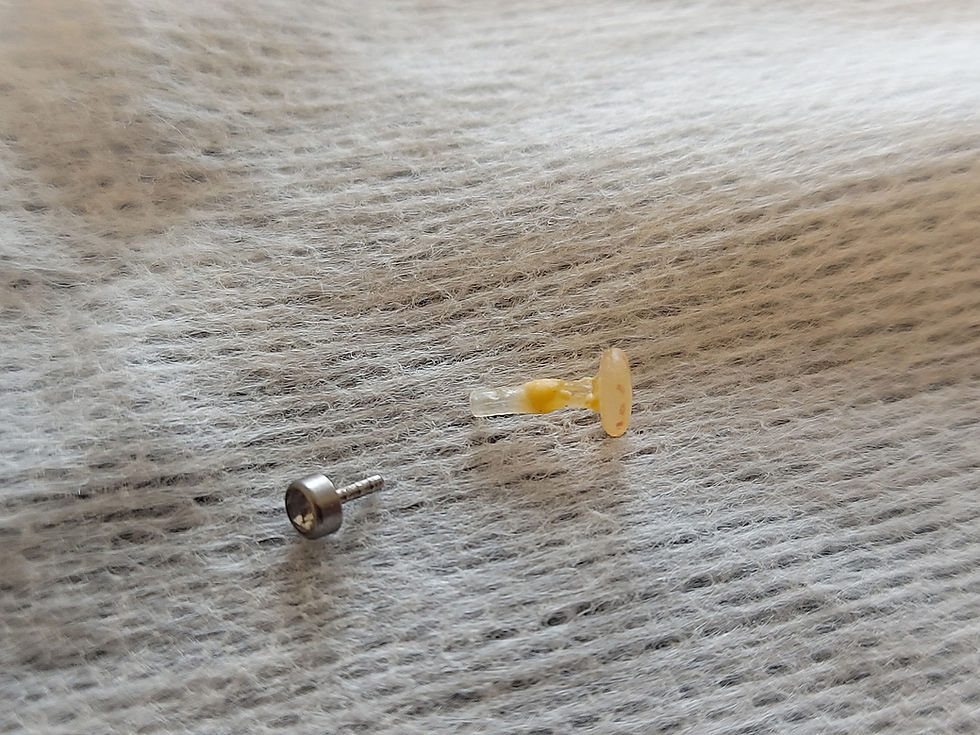
Plastic/bioflex/Teflon/acrylic jewelry: the surface is often porous, scratchable, and susceptible to micro-scratches. This traps sebum, dust, and bacteria, becoming a breeding ground for bacteria. Plastic often doesn't allow for proper sterilization or degrades over time (discoloration, scratches, cracks, yellowing, etc.).
So, what type of jewelry should you choose?
In terms of the shape and finish: a labret with a flat back disc, a mirror polish, and an internally threaded or threadless system is the best option. Depending on the piercing's location, another type of jewelry might be more suitable than a labret, of course: for example, barbells for nipple piercings, curved barbells for navel/rook/anti-tragus piercings, etc.
The length must be appropriate (neither too long nor too short), and the material must be approved as biocompatible, as indicated on the APP website: 14 or 18 karat gold (nickel-free), titanium (ASTM-F136 grade), niobium, steel (ASTM-F138 grade), or glass.
ASTM F136 titanium (often called implant-grade titanium) is the gold standard for professional piercing jewelry. It is a titanium alloy specifically formulated for medical use: the same type of metal used to make surgical implants such as bone screws, prostheses, and reconstruction plates.
The ASTM F136 designation refers to an American international standard defined by the American Society for Testing and Materials (ASTM). This standard guarantees that the metal meets very strict criteria for purity, mechanical strength, and biocompatibility.
It fulfills three important criteria:
1. Biocompatible: It does not release heavy metals, does not rust, and does not cause allergies.
2. Lightweight and strong: Approximately 40% lighter than steel, yet just as strong.
3. Sterilizable: It withstands the heat, pressure, and humidity of the autoclave without degrading.
It is currently the most recommended material for new piercings and the one required by the Association of Professional Piercers (APP) for professional use.


Why Some People Experience No Problems with Unsuitable Jewelry:
We've all heard it before: "I wear whatever I want and I've never had a problem."
And it's true: some people can wear low-quality jewelry for years without any visible irritation. But that doesn't mean the jewelry is risk-free—it simply means their body has tolerated it well so far.
Some people have very reactive skin, others don't. It's a bit like allergies: not everyone reacts to the same thing, or with the same intensity.
Just because a piece of jewelry "doesn't do anything" for someone doesn't mean it's healthy. It can still create invisible internal micro-irritations that go unnoticed but weaken the tissue in the long run.
The internal channel of a piercing is a very thin, small tunnel of skin. It can become fragile, deformed, or accumulate micro-scars without being visible from the outside. These weaknesses only become apparent later, when the jewelry is changed or an infection develops.
A low-quality material may be poorly polished, porous, or non-biocompatible, yet not cause any immediate reaction. But over time, it can retain more dirt, promote mild chronic inflammation, or make the channel more sensitive to future manipulation.
Let's not forget the element of luck! A poorly placed piercing or one done with low-quality jewelry may, by pure chance, heal properly. But it's often a fragile balance: the slightest impact, jewelry change, or weakened immune system can lead to problems (swelling, irritation, pain, loss of symmetry, etc.).
We might then find ourselves facing people who come to the studio saying, “I don’t understand, I’ve been wearing this jewelry for five years without any problems,” except that at some point, the body has had enough of the constant contact with this irritating piece, so it finally reacts.
And let’s not forget that “no problems” doesn’t mean “good results”! Often, people who have “never had any issues” wear tarnished or oxidized jewelry, sometimes have enlarged or deformed earlobes, or have simply become accustomed to a discomfort they consider “normal.” In reality, they’ve just learned to live with it.


Key takeaways:
Jewelry isn't just an accessory; it's an element implanted in the body.
Therefore, it's important to choose quality materials. European standards exist (nickel/REACH), but they aren't enough: you need to go further with professional standards (APP).
Consider your earlobes as a piercing in their own right: a hole/wound in the body. A lobe piercing deserves jewelry of the same quality as one in a cartilaginous area or any other part of the body. This helps prevent problems like chronic irritation or tearing.
Need help?
Don't hesitate to contact me and schedule an appointment if you'd like a professional opinion on one of your piercings! I'll check the material, the finish, the length/diameter of the jewelry, as well as the piercing itself, the angle, and the aftercare you've done.
I hope this article has helped you gain a clearer understanding and find your way more easily!
See you soon,
Sélina.


Comments